On December 3, Eric Chu, CMO of Waffo, joined the "What Can I Do" livestream hosted by ZHAO, a veteran Product Manager from the Chuhaiqu (Going Global) incubator.
Across a two-hour deep dive, the dialogue moved beyond technical AI prompts to address the structural global payment compliance traps that threaten the survival of lean developer teams.
The following are the edited highlights of their conversation on how to build a compliance infrastructure and recover lost revenue.
1. MoR vs. PSP: The Compliance Fortress for SaaS
ZHAO: Global payments are a labyrinth. Eric, you’ve outlined nearly ten "pitfalls" for us. Where does the bleeding start?
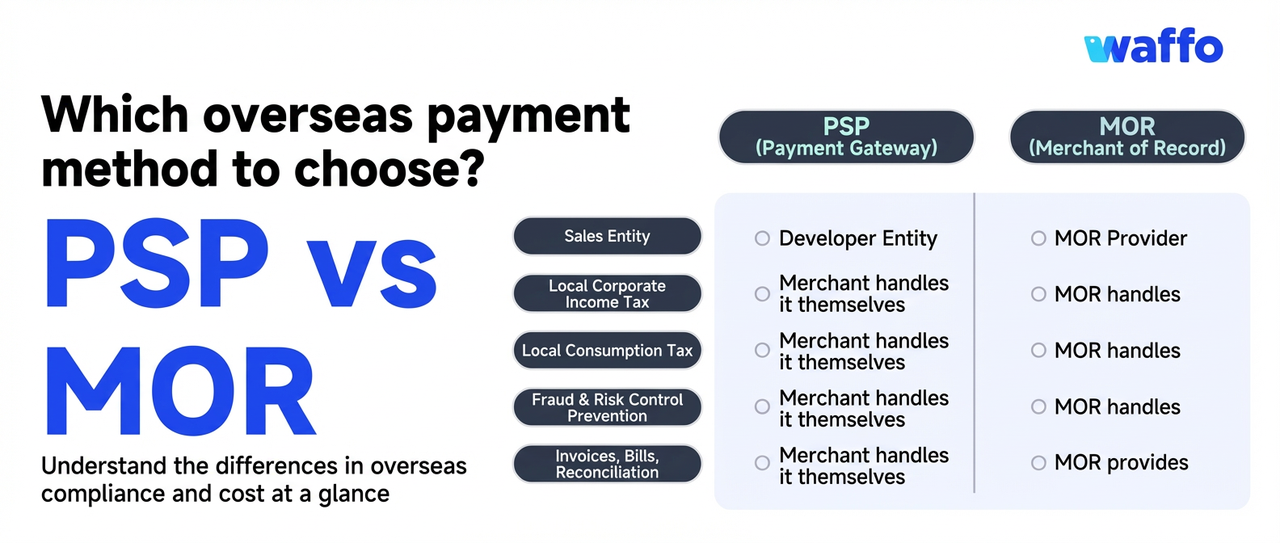
Eric: It starts at the foundation. For developers, the choice between a Payment Service Provider (PSP) and a [Merchant of Record (MoR)] is a choice of liability.
Eliminating Tax Filing Penalties
Under the PSP model, the developer carries the full weight of VAT/GST filing in 50+ jurisdictions. Conversely, Waffo’s MoR infrastructure assumes this legal tax liability, insulating startups from the "silent killer" of late-filing penalties—which can reach $25,000 in North America alone.
2. Reducing Chargeback Rates for Digital Subscriptions
ZHAO: A major anxiety for our community is the "Chargeback Rate." If you’re selling a digital subscription with no shipping label, aren't you destined to lose every dispute?
Eric: It’s a common fear, but not an inevitability. Waffo’s strategy for revenue recovery shifts the defense to digital footprints.
Strategy A: Dispute Initiation Alerts
Use "Dispute Initiation" alerts to refund a disgruntled user before it hits your official chargeback ratio, effectively lowering your risk profile by 30-40%.
Strategy B: Fixing the "Identity Gap"
If your product is named "AI Magic" but the credit card bill says "Waffo Tech," the user will report it as fraud. We ensure the billing descriptor matches the user's expectation.
Strategy C: Digital Footprints as Evidence
By documenting user activity logs and device fingerprints, we help creators build a verifiable chain of evidence to win disputes.
3. Checkout Optimization: Boosting Payment Success Rates
ZHAO: Many developers see a 70% payment success rate as a "Black Box." How do we reclaim that lost 30%?
Eric: Success rates are a system of metrics to be optimized. We focus on three levers:
Smart Retries: Intelligent retries for "Insufficient Funds" declines recover 3–5% of revenue.
Issuer Metadata Optimization: Correcting missing banking parameters can boost success by 2-3%.
High-Risk Category Routing: By onboarding through an MoR structure, we see broad-based lifts in authorization rates for SaaS products.
4. The True Cost of Payments: Base Rates vs. Operational Drain
ZHAO: A developer sees a 3.x% rate elsewhere and asks why Waffo’s "sticker price" might look different.
Eric: It’s like buying a car; the base model is never the final price. The true cost is hidden in cross-border fees, currency conversion (FX), and 3DS authentication costs.
If you only look at the base rate, you’re ignoring the operational drain. Our goal is to consolidate these fragmented costs into a transparent, all-in strategy so developers can stop playing accountant and start playing architect.
5. Conclusion: Moving at the Speed of AI
ZHAO: Do you have anything else to share with everyone?
Eric: Waffo was built for the "Digital Native" economy—SaaS, gaming, and AI. Backed by HSBC, Gaorong, and BAI Capital, we consolidate fragmented costs into a transparent global payments strategy.
If you are built to sprint in the AI revolution, we are here to clear the compliance track.